

“Do we trust these companies? Do we trust the current federal government to not issue subpoenas? Do we trust these companies to stand up for our rights?” an Albany resident asked during Albany’s discussion of a new automated license plate reader (ALPR) contract at the City Council meeting on Wednesday, September 8, 2026. His questions reflected major concerns aired throughout the meeting as residents and City officials talked about whether Albany should continue using ALPR technology for now.
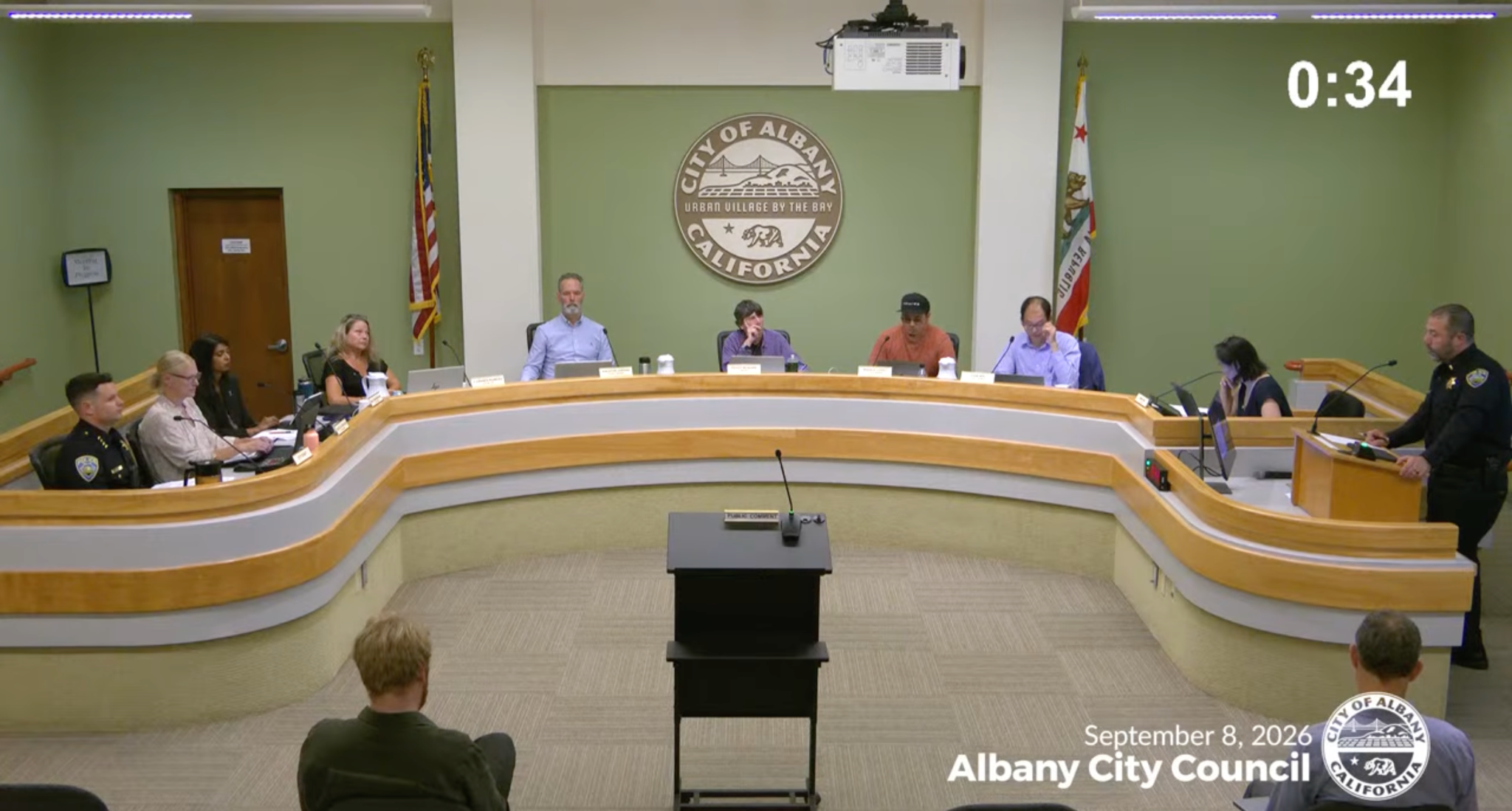
Albany Police Chief Greg Galliano helped introduce and articulate the police department’s reasoning regarding ALPRs. He reviewed the department’s support for a new Motorola Solutions System after the City’s Flock contract expires, while they continue to pilot Clancy’s 4-camera Parking Control ALPRs. He said that ALPRs have helped with many crime investigations, including hit-and-runs and commercial burglaries. Last spring, City Council had directed the department, based on police support for the technology, to carry out a competitive request for proposals and to report back on the best company to contract with.
This panel, that included representatives from public works and community development, evaluated proposals based on a criteria that focused on cost, transparency, governance, and effectiveness. Galliano said that the department was recommending the best company in light of Albany’s values. His department will maintain tight geographic and inter-agency controls on data sharing, while reducing the number of cameras to only those the department deemed effective.
The proposed five-year contract would have included 24 fixed solar-powered ALPR cameras, down from the 34-camera Flock system, and cost up to $318,745. Police also emphasized 30-day data retention, contract termination provisions, required documented reasons for police data searches, privacy restrictions, audits and controls on outside agency access.
With Mayor Peggy McQuaid having set the tone for civility and courtesy so no voices were left out of the conversation, the discussion on ALPRs was educational and inclusive. Public comments were largely opposed to the proposal, with assertions that the research does not demonstrate that the technology significantly reduces crime, particularly violent crime. Albany residents said ALPRs exacerbated concerns about privacy, the possibility of data being shared with outside agencies, including federal immigration authorities because the data lives in the cloud. Some speakers also brought up pending lawsuits and controversies involving Motorola Solutions and its affiliated company, Vigilant Solutions, for alleged inappropriate sharing of vehicle-location data. Motorola Solutions is involved in major lawsuits involving privacy rights that are still being adjudicated.
The opposing views created an unusual, but respectful, divide at the meeting, with police supporting the technology while many residents urging the Council to
reject it. Albany residents said that even with safeguards, the current risks associated with collecting and storing information about people’s movements were just too high. The Council ultimately voted not to move forward with the proposed Motorola Systems contract. With Albany’s Flock contract set to expire Sept.11, the decision meant the city will not replace its existing Flock system with the proposed Motorola technology.
The vote ended the current debate that went beyond which company should operate Albany’s cameras. It raised a larger question for the city about whether the potential investigative benefits of ALPR technology outweigh concerns about privacy, surveillance and control over residents’ data. For now the City erred on the side of caution, as litigation is still pending.
It was clear that the concern wasn’t so much about the professionalism of the Albany Police Department, as much as it was about the utility of the technology and outside companies that may lack the commitment to consistently safeguard community data and operate within the police department’s guardrails.
| –Sylva Roubinian |
All League News